
Economic, social, environmental and technological development framework

This macro-area provides an overview of the possible consequences in the national port system and in individual ports of all those dynamics, which the North Tyrrhenian Port Network Authority has nothing to do with, but which influence how they operate, affect their purpose and competitive nature and conditioning their effectiveness and efficiency.
The four main themes are:
- current global shipping and port sector scenarios;
- economic and social impact: exports, logistics, cruise industry;
- the interface with environmental energy planning;
- the applications and Smart IT services for the Ports and the entire system.
The DPSS recognizes these basic issues as external factors but very influential on the national port system itself. Even if the DPPS document cannot directly affect the strategic choices, it is essential to take them into account in order to better calibrate and construct objectives, strategies and actions.
The very nature of the port system is complex and requires a complete analysis and assessment of all possible scenarios for its correct progressive development. It is therefore easy to understand how this chapter is crucially important for the whole document.
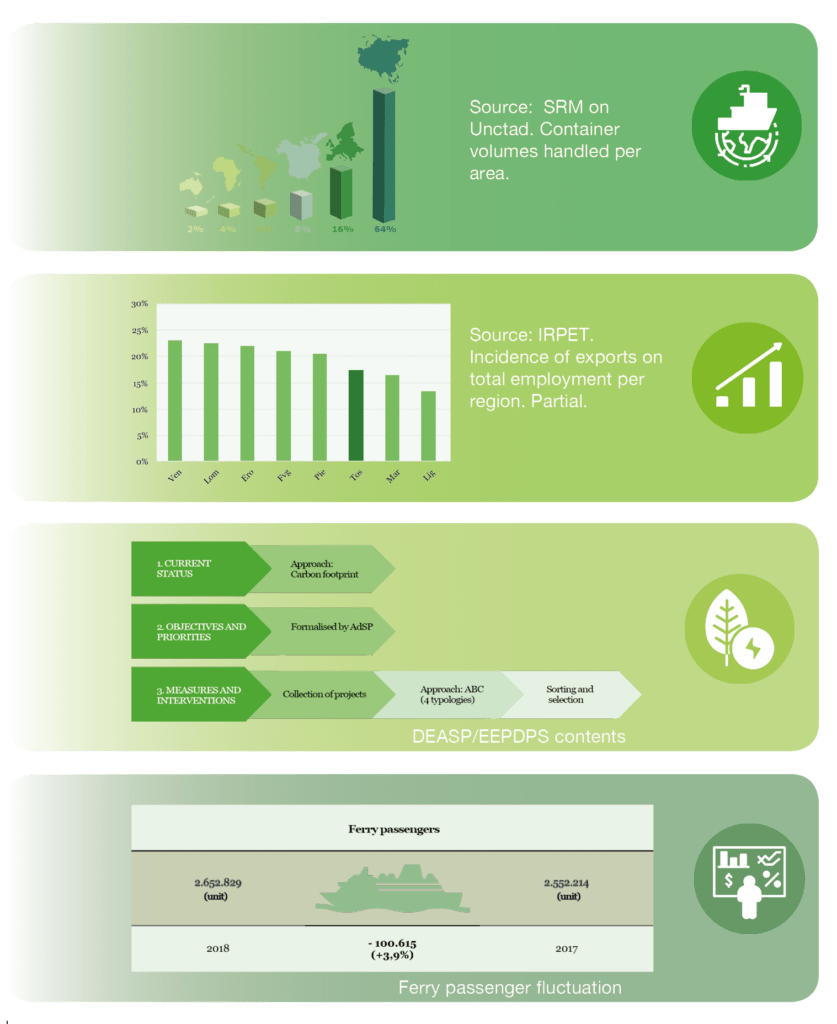
Current global shipping and port scenarios
The analysis of these aspects aims to provide a complete picture in order to know the context in which the North Tyrrhenian Port Network Authority operates.
First, the current global shipping scenario will be analyzed and then, at local level, we will focus on individual ports and their geographic context.
The detailed economic aspects will focus on national and international scenarios related to the evolution of logistics and shipping, with an analysis of global trade, Mediterranean and European scenarios, the market in the MENA area and new shipping routes.
Economic and social implications: exports, logistics and the cruise sector
Socio-economic aspects in terms of employment and economies of scale, on the other hand, are used to evaluate and understand the direct and indirect impact at regional network level.
Tuscany is an export-oriented region and, at the same time, a major importer of raw materials. This Is why the coastal logistics platform considers the port nodes as the heart of the regional economy.
Tuscany’s cultural heritage and the beauty of its landscape attracts tourists from all over the world. The cruise sector plays a leading role in its regional tourism system.
The relationship with environmental energy planning
Considerable importance is given to environmental issues. They have been discussed in depth in the Port Network’s Energy and Environmental Planning Document (DEASP/EEPDPS), devised by the Port Network Authority.
A small focus on this Document and the relationship between the two plans will be included in the DPSS.
Smart applications and IT services
The analysis of the North Tyrrhenian Port Network Authority’s applications also involves new smart solutions and Big Data management. This will consent, for the first time since the last reform on the subject, a complete assessment of current shortcomings and critical points related to these issues.
The current overview of the North Tyrrhenian Port Network Authority’s applications, with reference to new smart solutions and big data management, makes it possible for the first time since the reform, to make an assessment of the current shortcomings and critical issues on the subject.
In the development of the DPSS project, it will therefore be possible to envisage calibrated, effective “smart” actions, policies and guidelines, which are now essential in the global, connected world in which the Port Network Authority operates.
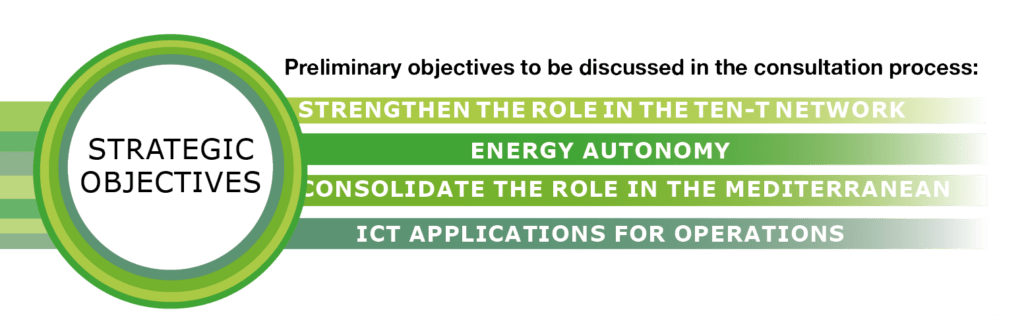
It should be stressed that these underlying themes are those most strongly affected by the multi-level crisis that began in March 2020 due to the COVID_19 pandemic. It will therefore be necessary to update this chapter, which was written prior to the emergency.
The North Tyrrhenian Port Network Authority and its Strategic Planning Office are constantly monitoring and analyzing the dynamics and repercussions caused by the emergency, in order to carry out the necessary thematic corrections when drafting the final DPSS.