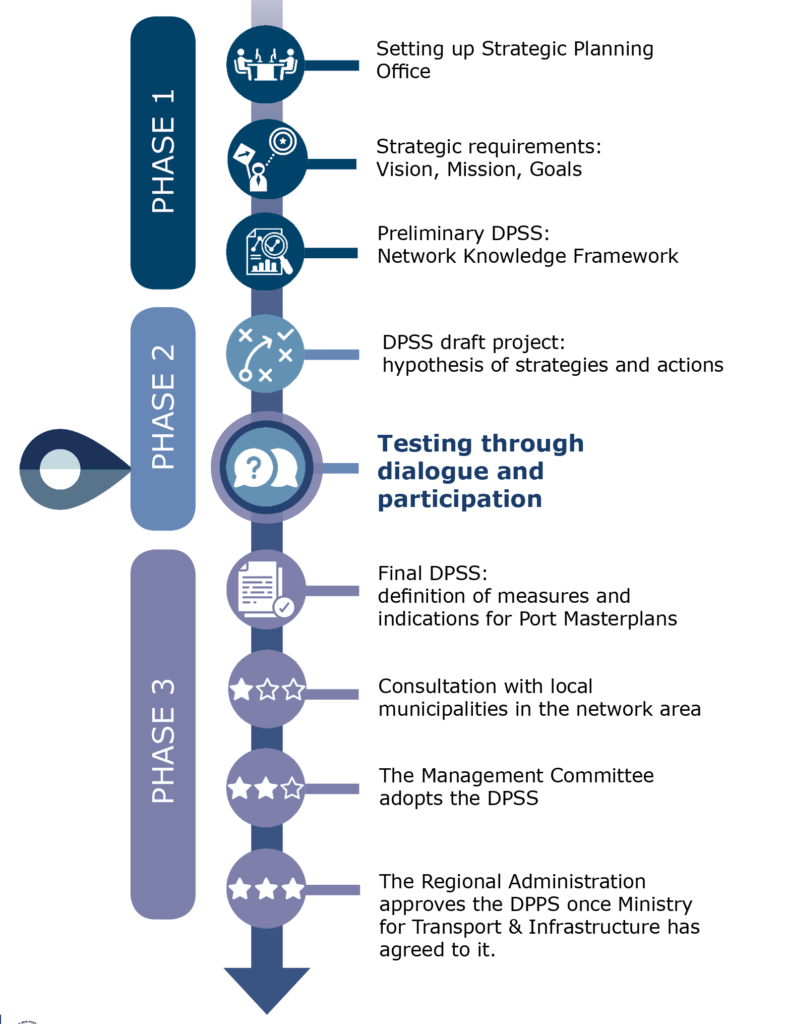
With the reform, Port Network Authorities are called to measure themselves against a very pioneering and experimental scenario, as there are currently no specific guidelines (after only one year, the 2017 Ministry for Transport & Infrastructure guidelines are considered outdated) or examples to follow.
With the guidance of the DPSS, each Port Network Authority is exploring various planning concepts, and personalizing the strategic component, the consistency and multidisciplinarity of the knowledge framework, the involvement of stakeholders and the in-depth project analysis, the final output of the guidelines, etc…
Fortunately, the North Tyrrhenian Port Network Authority’s DPSS is based on consolidated studies and outcomes of the recent Livorno and Piombino Port Masterplans, which, in many areas, anticipate the reform. The two Port Masterplans have been developed through specialized engineering and environmental studies on existing ports and their possible expansions. These studies investigate both infrastructure and last mile issues as well as the interaction between the port and the city and their relationship; the real novelties of the reform.
In order make the best use of the most innovative aspects that have been introduced with the reform, other consolidated experiences of spatial planning, environmental planning, mobility and infrastructure have been analyzed, with a view to extrapolating tools and methods to apply to specific port planning practices and regulations:
- The division of port planning into two levels is facilitated by the vast experience acquired in Tuscany with its particularly advanced regional and urban planning systems
- Designing the new strategic supply chain (objectives-strategies-actions) introduced by the amendment to Law No. 84/94, has involved incorporating and adapting Sustainable Mobility Plans and Strategic Plans for large regional areas.
- Developing the new knowledge framework at network level, which will provide the basis for the new operational Port Masterplans, has involved readapting the logical development framework of urban planning schemes and the Tuscan Regional Policy Plans.
- Devising scenarios (current -reference-project) has involved adapting the framework of the Sustainable Mobility Urban Plans and Infrastructure as codified at European level in the SUMP-Eltis guidelines
- The involvement of public bodies, stakeholders and local entrepreneurs is fundamental for developing strategic guidelines and actions at Port Network level. In order to do this, we have drawn on experiences of participatory paths consistent with indications at European level (SUMP-Eltis) national (VIA-VAS & MIT guidelines for the PUMS) and Tuscan (Law 46/2013).
- In order to provide guidance to Port Masterplans and actions for the whole port network, “strategic area factsheets” will be provided along with the rules governing their use, similarly to what has been done in Tuscany Regional Administration’s Regional Policy Plan and in many urban planning schemes.